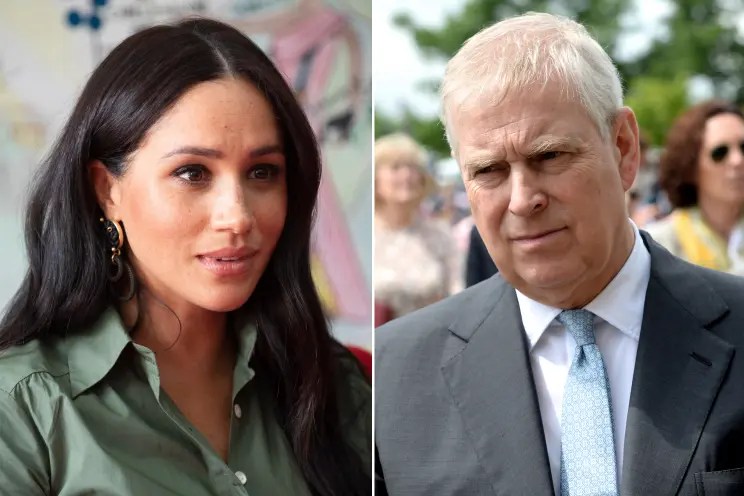
Meghan, Duchess of Sussex vs. Andrew Mountbatten-Windsor
In light of the release of the posthumous memoir, Nobody’s Girl by Virginia Giuffre, Andrew Mountbatten-Windsor was formally stripped of all titles bestowed upon him and those of his supposed birthright. Despite Andrew having settled outside of court with Queen Elizabeth’s personal funds (not the least amount of which is in part thanks to the British Royal Family’s personal hand in managing the TransAtlantic Slave Trade), the outrage persisted until it came to a boiling point upon the release of the book. The tragedy that brought the world to this moment was the story of a fight for justice by Virginia, the other victims of Jeffery Epstein and Ghilaine Maxwell, and an outraged public. Andrew giving up his titles was not his choice – not by a longshot.
The memoir had just been released and the anger toward Jeffery Epstein (deceased) and Ghislaine Maxwell (imprisoned) was redirected at Andrew who was also name-dropped by Virginia in the book. Discussions of having the British Parliament vote on removing his titles circulated globally online and the mainstream media. On October 18th 2025, Andrew put forth a statement announcing that he was willingly giving up all royal titles and honors, including the “Duke of York” title he most often went by and was used in lieu of a last name like most British royals. But it wasn’t enough. The discussions continued because he declined to include the two arguably most significant titles of all: “His Royal Highness” and “Prince”. In order to force him to remove those titles, Parliament would have to vote on it. Seeing the writing on the wall, King Charles III finally made the decision to strip the titles from his brother himself. This could have been a lesson learned from either Andrew’s disastrous PR in the wake of the 2019 allegations or the king’s own interviews following his infamous divorce from Princess Diana.
That being said, Andrew – and most of the British Royal Family in general – continue their fatal flaw, a precedent set forth by Queen Elizabeth II, “Never complain, never explain.” It’s pretty laughable when you consider the aforementioned interviews, but the motto does something else: if the royal family does not apologize, it does not admit wrongdoing. But in a modern world, this is wholly unsustainable; the world now asks for accountability and repariations. King Charles III had foresight for this issue to a point, when during his coronation, was the first member of the British Royal Family to publicly acknowledge its role in slavery, “I cannot describe the depths of my personal sorrow at the suffering of many, as I continue to deepen my understanding of slavery’s enduring impact”. And while this may be a step in the right direction, it is, frankly, not enough. In the words of former Royal Rota reporter Omid Scobie, “For the monarchy which has enjoyed glory for so long, to throw it all away simply over this resistance to change, this resistance to accountability, would be such a wasted opportunity.“
So why is there such a global fascination with and repeated reporting of parallels between an (alleged) pedophile who settled out of court, was stripped of all royal titles, and essentially banished into obscurity for his wrongdoings, with the first woman of color to marry into the British Royal Family?
I, as an American woman and amateur royal watcher, The Crown enthusiast, and Bridgerton fan, have little to no stakes in the debate. The British Royal Family has no authority over me, Meghan Duchess of Sussex was not someone I’d ever heard of before her wedding to Prince Harry (having been too young to know what Suits was), and had a healthy interest in world history as a child. Like most American women, I know who Princess Diana was, I know that Charles cheated on her, and the tragedy that followed. Most American women would probably also tell you that the only interest they have in the British monarchy is that the ruler was a Queen, a woman head of state, and that the weddings were elaborate fantasies and fun to watch.
Many American women therefore, made a lot of comparisons between Meghan and Diana: both were not royal before their marriages, both were not happy in their time at the palace, and both were harassed extensively by the British media. So why was the late Princess Diana remembered fondly – in spite of her scandals – and Meghan, Duchess of Sussex thought of as the trouble-maker, attention-seeker, and thorn in the Royal Family’s side? The answer is both insultingly simple and wildly complicated, but ultimately, the answer can be found in the main question of this article: Why are Andrew and Meghan compared?
Let’s get the obvious out of the way first by contrasting the two. Andrew is a white man; Meghan is a mix-raced woman. Andrew was born into the Royal Family and a British man by birth; Meghan married into it, a divorcee, and is American. These are the simple, more obvious differences without getting into Andrew’s (alleged) extracurricular activities.
The reason these two are compared is mostly due to the fact that both were once senior working royals – this translates to doing charity events, meet-and-greets, award ceremonies and the like – and then both left this job. The Firm – as the business side of the Royal Family is referred to – has to manage their daily activities and schedules. The Firm acts as an employer for the Royal Family. When you step away, The Firm no longer manages you or protects you. However, some might disagree that Andrew in particular still reaped the benefits of a senior royal: Andrew and his ex-wife lived at a Royal Residence, The Royal Lodge, a publicly owned and funded property given up by King George III who surrendered it to Parliament. Notably, the couple did not pay taxes on the home for at least 20 years. As briefly mentioned above, we also know that the late Queen Elizabeth II used her personal funds to settle Andrew’s case outside of court. And prior to all of these scandals, Andrew “stepped away” from being a senior working royal, the implicit implication being that it was a choice. It was something to show that while not admitting to wrongdoing, it was a “best for everyone if I walk away” idea.
Which finally brings us to Meghan. While Meghan was a working senior royal, the scandals included: her father’s relations with the paparazzi, her choice to walk down the aisle alone, making Kate Middleton cry as a dress fitting for the wedding, and – the most talked about of all – having cried in public over her portrayal in the media. We also know from Prince Harry, Duke of Sussex, that Meghan had voiced her frustrations and fear of the media, which finally prompted Harry to discuss leaving life as a working senior royal. To exemplify this, BuzzFeed.News did a direct comparison of how the British media portrayed the same acts, looks, and events of Kate Middleton, Princess of Wales, and Meghan.
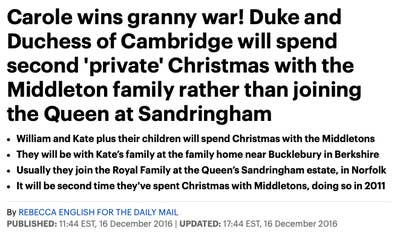
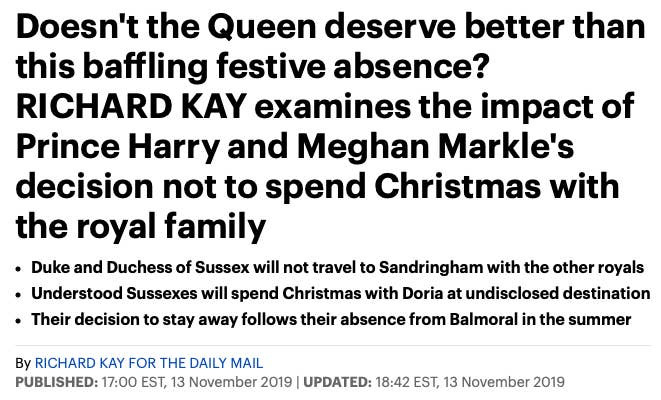
It is also worth noting that Rebecca English, author of the former article, had dubious allegations documented in Harry’s civil suit regarding the handling of Royal Family news, including spying on his ex-girlfriend. According to Endgame: Inside the Royal Family and the Monarchy’s Fight for Survival, by Omid Scobie, a former royal rota reporter, the Royal Family went so far as to make a deal with the rota: cover the now-Wales’ positively to elevate the future king’s image, and cover the Sussexes as the difficult, troubled couple, as they had done between Prince William and Harry back in the day when William was not the favorable prince in the eyes of the public for being lazy and moody.
Finally, when you account for how Meghan’s own famous Oprah interview hit the scene, the allegations toward her in-laws were brutal: there was racism, gaslighting, exclusion, and general pettiness implied. It was unfortunately very apparent that while Meghan loved Harry, she was almost disbelievingly naive about how the history and present day Royal Family operate. Many blamed her for her ignorance, but in my humble opinion, I feel that it is the partner’s job to be a bridge between their family and new spouse. And it seemed that no one had prepared her for the new life she’d gotten into.
All of this to say: Why are Andrew and Meghan always compared? Most of the above reasons would lead people to see resemblances between Meghan and Queen Camilla, of all working senior royals: prior divorce, marrying in, family not quite approving of said marriage, concerns for The Crown’s image, and so on. The answer is this: the media, the Firm, and the Royal Family themselves understand that Andrew is not looked upon favorably by anyone today. Therefore, if all accounts made direct lines between Andrew and Meghan, the heat was taken off of Queen Elizabeth II for her handling of the situation, the future King Charles III for his reputation being laced with scandal after scandal – not to mention an already disillusioned public – and finally, William, who lives in the shadow of his wife Kate, and needed better press attention; the head of state being overshadowed by fashion tabloids was not favorable to the Royal Family’s survival.
Back to the late Queen’s motto: “Never complain, never explain.” Meghan broke this rule; Andrew did not. Meghan left when she admitted life in Britain had become too much. Andrew never admitted to wrongdoing and was only forced out when it hit a breaking point. In the end, the British Royal Family truly is in the endgame: if it continues to never explain or complain, the general population is ready to do away with them. The money used to protect Andrew, the lack of accountability for anything regarding Meghan or the Royal Family’s role in history, and the facade of nobility cracking under pressure is not something you’ll often see British media talking about because they can’t. But maybe after all, the Pandora’s Box that is the “Epstein Files” will truly be the choice The Crown has to make: modernize and take accountability, or don’t.
 Nicolette, MPH